
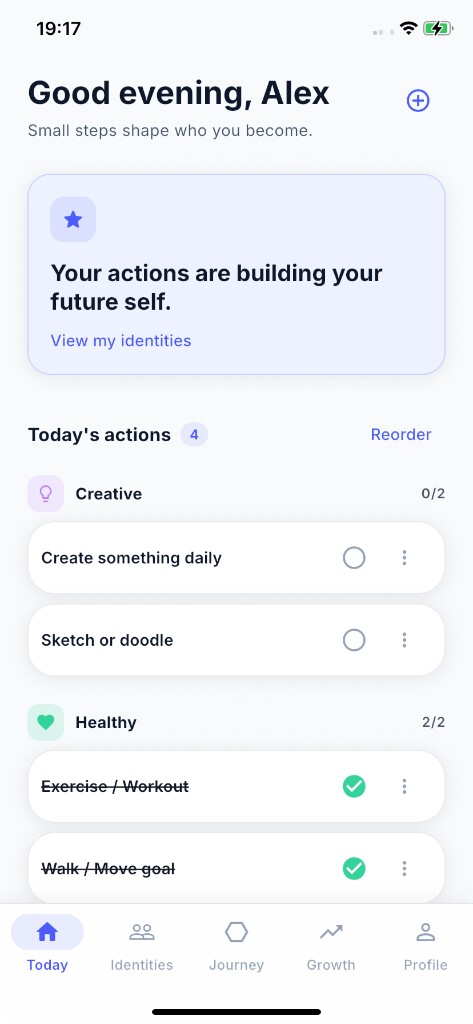
Traditional lists vs Ascend
| Traditional | Ascend |
|---|---|
| 50 tasks | 1 next action |
| Priorities | Momentum |
| Streak pressure | Rescue mode |
| Planning | Starting |
Overwhelm is often a UI problem
If every open loop lives in one scroll, your brain has to pick a door in a hallway of doors. That is a decision tax. People with ADHD pay it with interest. A "priority" label does not remove the hallway. It adds a second job: ranking.
Ascend shows one next action on purpose. Not because the rest of life disappeared. Because the start cannot compete with a wall of unfinished business.
Planning vs starting
A lot of to-do apps reward the planning session. Color tags, projects, subtasks, filters. You can spend an hour making the list feel manageable and never touch the actual work. The app congratulates you for organization. Your body still has not entered the task.
Ascend flips the order. One next action on Today. Momentum over priorities. Rescue mode instead of streak pressure. The question on the screen is not "what is your whole life?" It is "what is the smallest honest start right now?"
What to do with the rest of the list
The other tasks are not deleted. They wait. After you complete or honestly attempt the next action, the screen advances. You are not pretending the backlog does not exist. You are refusing to let it block the first move.
If you miss days, Rescue Mode picks the easiest win and continues. No zero-day reset. No lecture. That matters because streak-based apps teach you that a gap means failure. For a brain that already struggles to start, failure language makes the list heavier, not lighter.
A day with one next action
Morning: open Ascend, see one line. Not forty. Do two minutes of it or honestly attempt it. Close the app. The rest of your list still exists somewhere else if you need it.
Afternoon freeze: run Start Anyway physically, then return to the same next action if it is still the right one. Evening: if you missed the morning, Rescue Mode instead of reorganizing the whole backlog.
The point is not to live only in Ascend. The point is to stop the list from blocking the first move every single time.
Who this comparison is for
If you reorganize tasks more than you complete them, read this page twice. If you already start easily and only need better prioritization, a traditional app may be enough.
Ascend is for the freeze before the first click. One next action is the product decision, not a missing feature. The rest of your system can live elsewhere.
Try it on a stuck afternoon
Pick the one task you have avoided longest. Put it as the only next action. Run Start Anyway physically, then two minutes on that line. Notice whether the list or the start was the real bottleneck.
Note: Ascend is a habit and identity tracking app, not medical or clinical treatment. If you are in crisis or need professional support, please contact a qualified healthcare provider or local helpline.
FAQ
Is Ascend an ADHD productivity app?
No. Ascend is for people who know what to do but cannot start. The goal is one tiny action, then continuing after missed days without shame. It is not a diagnosis tool or a treatment.
Is this medical advice?
No. Ascend is a habit app. If you need clinical support for ADHD or mental health, talk to a qualified professional.
What happens if I miss a few days?
You continue. Rescue Mode and Recover From a Bad Day are built so a gap does not reset your momentum or send you into a shame spiral.