
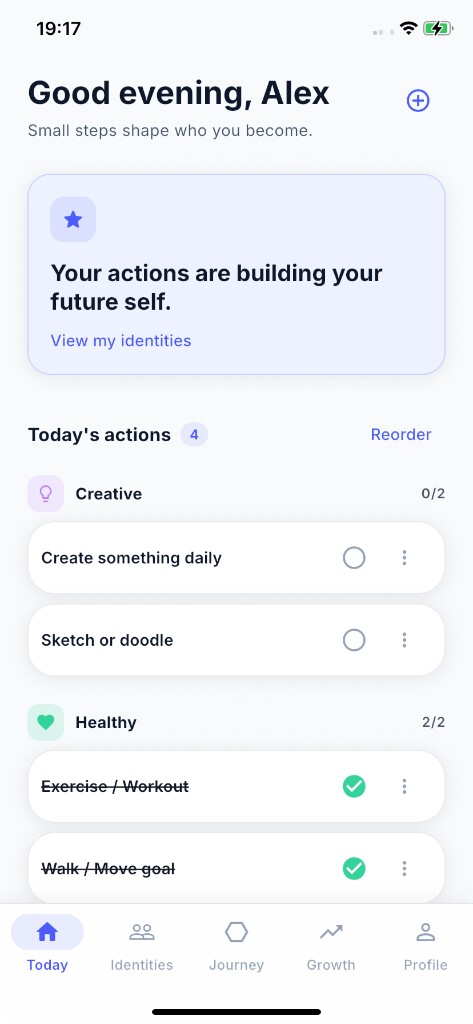
You're not short on willpower. You're short on a clear answer.
A lot of people download habit trackers not because they know exactly which habits to build, but because they have a general feeling that things could be better. The problem is that most trackers assume you've already done the hard part: deciding who you're trying to become: and just want you to log a list.
Without that answer, the list feels arbitrary. You add habits because they sound good, not because they're tied to anything, and they fall away the first busy week that comes along.
Ascend starts with the question itself.
Before anything else, Ascend has you sit with the question: who do you want to become? Not a job title or a number on a scale: an identity, like "a calmer person" or "someone who finishes what they start." That answer becomes the anchor for everything else.
From there, you attach a couple of small actions to that identity and start showing up daily. The habits stop feeling arbitrary because they're clearly in service of the answer you gave yourself.
Built for people still figuring out the answer
- The question comes first: A who do you want to become app should start with that exact question, not a template habit list.
- Small first actions: Attach just one or two actions to start: you can add more once it sticks.
- Weekly review: Revisit your answer regularly and see how your week matched it.
- Private by default: Your answers and actions are stored locally on your device.
How to start this week
If you searched for a who do you want to become app, you probably already know what you want to change. The hard part is making daily behaviour match that intention when motivation dips. Ascend starts with one identity instead of a long habit list.
Pick "the honest answer to who you want to become" and attach two small actions: writing your identity in one sentence each morning and taking one small action that matches it. Size them for your worst week, not your best. Ten minutes total is enough if you repeat it.
Track for seven days without adding anything new. Your weekly review shows whether actions matched the identity — that signal is more useful than an unbroken streak.
When a day goes sideways, log it honestly and return tomorrow. The goal is not perfection; it is proof that you keep voting for the same identity even on ordinary days.
What changes after a month
After a few weeks, the habit list stops feeling arbitrary because every action serves your answer. You are not chasing a number on a checklist. You are collecting evidence that you are the kind of person who follows through on ordinary days.
If you have quit habit apps before, the difference is what happens after a miss. Alignment drops for a day; it does not erase the identity. You open the app, log what happened, and take the next small vote tomorrow.
By week four, the identity starts to feel familiar. You stop debating whether to do the action and start noticing when you skip it. That shift — from forcing to recognising — is when the habit stops feeling like a project and starts feeling like you.
FAQ
What is a who do you want to become app supposed to do?
It should help you answer the identity question first, then turn that answer into a short list of daily actions. Ascend works exactly this way: you name the identity, attach a couple of small actions, and build from there instead of starting with an arbitrary habit list.
Is Ascend free?
Yes, Ascend is free to download, with an optional Ascend Pro subscription for more identities and deeper insights.
Does my data leave my device?
No. Everything you enter about your identities and actions stays stored locally on your device.